
Optional Attendance
On synthetic users, research slop, and the cost of showing up whole
Your body always knows who’s actually there.
A friend I’ve known for years and I are at dinner and she’s left her phone face-up on the table. This is how it has become with her.
I’m telling her about my week. Not the real version, but the version I’ve learned to tell her — shorter, lighter, asking less of her attention than I actually need. My body knows the rhythm now: start talking, watch her eyes, wait for the screen to glow, feel the sentence go slack in my mouth. I’ve been through this enough times that I no longer start the sentences that matter.
Her phone lights up. She picks it up, reads, types something back. I don’t know who she’s talking to. She doesn’t say. She puts it down.
“Sorry — go ahead,” she says.
But it wasn’t always like this.
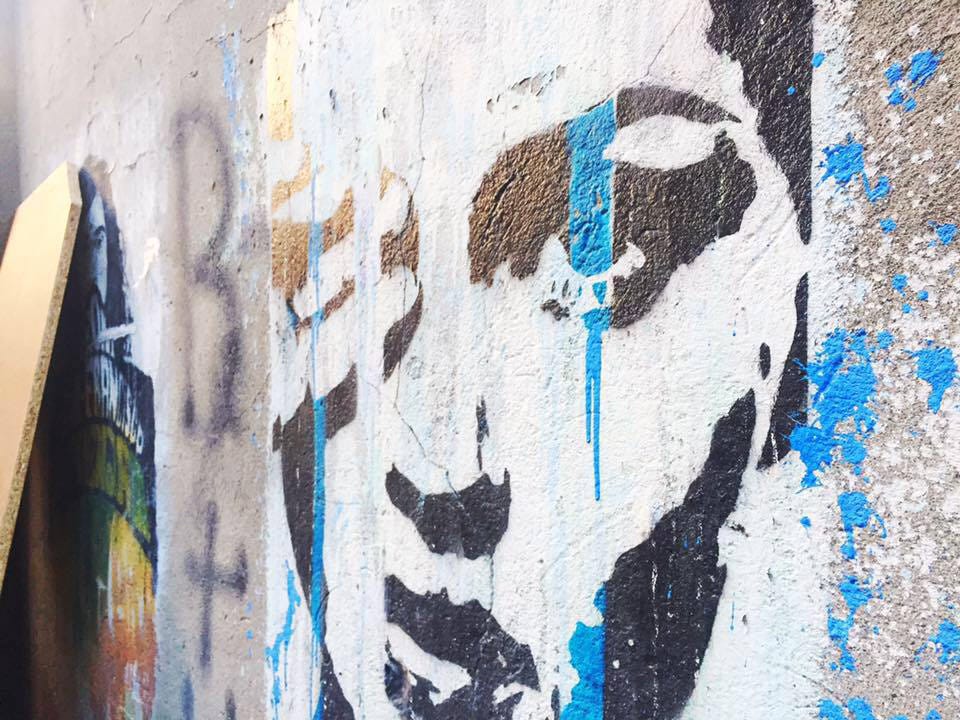
There’s a cavernous bar in Tbilisi, Georgia, where the art glows on the walls and everything is cast in off-orange light. It’s 1am. We’re taking shots of cha-cha — Georgian grape brandy, the kind that strips your throat like old paint — with strangers we’ll never see again. The doors open to a spiraling stairwell, then cobblestones.
We used to work together before we each moved into our own versions of tech. She went into compliance. I went into research. We grew in parallel and stayed close.
Her phone never left her bag that night. We were arguing about whether institutions make people corrupt or whether people arrive that way, then laughing so hard I couldn’t breathe, then circling back to the hard questions without skipping a beat. That was us.
At home it was the same. Russian pop blasting late into the night — both of us having built previous lives in the former Soviet Union — circling questions without answers, and not caring that they didn’t resolve. I remember feeling one hundred percent myself with her. In every way. All the time.
The truth is I don’t know how you get from that night to this table. It doesn’t happen in one moment. It happens in the space between moments — the slow accumulation of times when you reach for someone and they aren’t quite there.
So I go ahead with the easy version. The thing I actually need to say stays in my chest. I’ve learned this table isn’t where it’s going to land.
I still show up to dinner. And I will keep showing up.
Most of us know this story. A friend who hears you next to a friend who nods along. A manager who makes use of what you bring versus one who has already decided what he’s going to do. Your body keeps score. Over time, you learn to pre-edit — to show up already adjusted for the amount of attention you’re going to get.
Silence isn’t accidental. It’s structural.
I’ve been in rooms like this at more than one company. The details change. The shape doesn’t.
It’s a monthly video call for a team redesigning something people depend on. The invite goes to a hundred people. Twenty-some show up, cameras mostly off. A senior leader plays a pre-determined set of recordings — customer service calls she’s hand-selected herself. The caller on the line apologizes before she even starts: “I’m sorry, I know you’re busy,”with the sort of flatness of someone who has exhausted every avenue to resolution already.
The leader pauses the recording. She has a redesign in mind already, fully formed — she knew what she wanted to build before she ever pressed play. The calls aren’t discovery. They’re evidence, reverse-engineered — justification for a redesign she’s already decided to build. Pick the right calls and the conclusion writes itself.
I look at the grid of muted names. I can’t see reactions — just blank rectangles, plausibly present. Someone might be bristling like I am; someone might be making tea. The system is designed so I can’t know who sees what I see. And that not-knowing keeps everyone quiet.
I say what I see. After the call, I reach out individually to a few people — the ones who might be willing to talk. Some are. Some aren’t. It isn’t that no one saw it. It’s that no one wants to be the only one saying it.
Silence isn’t accidental. It’s structural.
But I’ve also sat in rooms where people came with questions they actually want answered. Where changing course is a real possibility. In those rooms, the work changes what gets built — not necessarily because I’m persuasive, but because the people across from me are open to being wrong.
It comes from the same place.
Either the person across from you is willing to be changed by what they hear, or they’re performing a version of presence that doesn’t require you at all.
My friend in Tbilisi was there. The leader on the call was not.

Slop is not a tech problem. It’s an old one.
What shipped after that call was a redesign of an experience millions of people depend on to make decisions they can’t afford to get wrong. The interface was cleaner. The steps were fewer. Completion rates improved.
But faster is not the same as understood.
I had spent two months walking with real people through the full experience — following up over weeks, tracking whether understanding held or fractured over time. I sat with people as they tried to explain back to me what they had just chosen and watched the confidence drain from their faces. Yes, they could complete the process. No, they did not always understand what they had chosen.
The documentation existed. The transcripts existed. The longitudinal tracking existed. It wasn’t invisible. But it was inconvenient.
What replaced it was a smaller, controlled study measuring whether people could get to the end. Yes or no. They could. Success.
In one version, you begin with the question and let the answer change you. In the other, you begin with the answer and assemble the evidence to support it.
There’s a term for this in tech — slop. It usually means AI-generated work passed off as real. But slop didn’t start with AI. It’s work that has the shape of substance without the substance itself. The hand-picked calls were slop. The study that tested for completion instead of comprehension was slop. It has the shape of research the way a mannequin has the shape of a person.
AI didn’t invent that instinct. It scaled it.
Performance scales. Presence doesn’t.
When we talk about AI slop, we talk as if the technology created the problem. It didn’t. It inherited a preference for performance over presence.
Every two weeks, a new tool. Designers generating dozens of AI icon variations for decisions no one would remember a week later. Using the tool had become the point.
The next step feels inevitable: the synthetic user. An AI simulation of a real person, designed to replace the conversation you could actually have.
My friend says “sorry, go ahead” and picks up her phone. The woman on the recording says “I’m sorry, I know you’re busy” and explains what went wrong. Two people apologizing when they have nothing to apologize for. One because she’s already halfway somewhere else; the other because she’s been taught that needing something is an imposition.
Somewhere a woman is still on hold, apologizing for calling. And I am still at dinner, telling the easy version.
I do this not because I’ve given up, but because I’m afraid of what happens if I don’t. If I say the real thing — that I miss her, that I need her to put the phone down — she might look at me and not know what I’m talking about. Or worse, she might know exactly what I’m talking about and decide it’s too much.
The smaller version is still something.
And every dinner where I tell the easy version, I am a synthetic version of myself — performing just enough to maintain our connection without risking the thing that might actually save it.
The only proof is the work itself.
What I have come to understand is that systems have personalities too.
Some reward discovery. Some reward momentum. Some reward visible change over slow understanding. You can do rigorous work inside any of them. The question is whether rigor is the thing that moves decisions.
I kept drafting test plans. I kept connecting with executive assistants to get fifteen minutes on calendars that were never designed for me. Sometimes it worked. Sometimes it didn’t. I walked senior leaders through what I’d learned from real people, tracked over real time. I showed my work — not because rigor guaranteed influence, but because it was the only way I knew how to stand behind what I was recommending.
Eventually, I understood that some decisions were made before the readout. That completion metrics would often win over comprehension because they were cleaner, easier to defend. Convenience has gravity.
But the alternative — showing up with just a number, or a summary slide without underlying proof — felt worse. The day I start optimizing for what moves fastest is the day I become indistinguishable from the thing I’m critiquing.
So I keep bringing the longer version. Even when the room prefers the shorter one. At work. At dinner. I don’t know yet if it changes anything.
I only know who I become if I don’t.
Have had about a hundred million work 1-1s exactly like this. You eventually learn that your role there is just to mirror back whatever that person wants to hear, not to share. It’s demoralizing but conserves your energy. But I find that conserving energy doesn’t always lead to more total energy, it often leads to less.
The work slop thing is impossible for me to bear, and it’s my biggest advantage and probably the biggest thing holding me back because I’m just not capable of pretending at scale.
“Over time, you learn to pre-edit — to show up already adjusted for the amount of attention you’re going to get.”
So profoundly true, Rachel. Carl Rogers and Heinz Kohut write about how the parts of us that are seen and accepted by others become integrated into our self. The parts that are not seen (paid attention to) get split off and dissociated. We become smaller and frailer in the absence of others who will pay full attention. Our distracted culture (phones, overwork) makes it very difficult to find people who can listen and see who we are.